Who were the Knights Templar? Rise and Fall of the Knights of the Temple
- Jan 19, 2025
- 8 min read
Updated: Oct 14, 2025
At the dawn of the 12th century, Europe breathed both anxiety and hope. From the monasteries came sermons about the Holy Land, while from the castles echoed the clatter of arms — the crusaders sought not only victory but also meaning. Along the roads that led pilgrims to Jerusalem, a daring idea was born: to unite the monastic vow with the knightly duty.

Around 1119, a knight from Champagne, Hugues de Payens, together with several companions, swore an oath to protect travelers and serve God with the sword. Thus emerged the Order of the Temple — a brotherhood that placed humility and discipline on the same level as martial valor. Their home became the holy sites of Jerusalem, their rule, prayer, poverty, and vigilance.
Yet from their very first steps, the Order seemed to be more than a simple guard of the roads. There was mystery in their image, authority in their silence, and within their determination — the faint shadow of a coming tragedy. The Templars quickly became a symbol of an age that had two faces — sanctity and steel. This is not merely a chronicle of dates and wars, but a legend of how faith could raise a knight to the heights of glory — and one day, lead him to the fire of the pyre.
The Founding of the Order and Its Mission
After the Order’s founding in 1119, the Templars remained for a long time a modest brotherhood. There were only nine of them, and their mission seemed simple — to protect pilgrims on their way to the holy sites. Yet behind this outward humility lay an idea far stronger than the sword itself.
The Templars combined monastic humility with martial determination. They prayed before battle, slept in their armor, owned no personal property, and obeyed a strict code in which every detail — from food to speech — was devoted to the service of God.
The turning point came with the patronage of Saint Bernard of Clairvaux, the spiritual leader of his age. It was he who wrote the treatise “In Praise of the New Knighthood,” in which he exalted the Order as a union of faith and valor. Through his influence over the Church and monarchs, the Order of the Temple received official recognition at the Council of Troyes in 1129. From that moment on, the white mantle with the red cross became more than just a symbol — it represented purity of intention and the readiness to shed blood in the name of Christ.
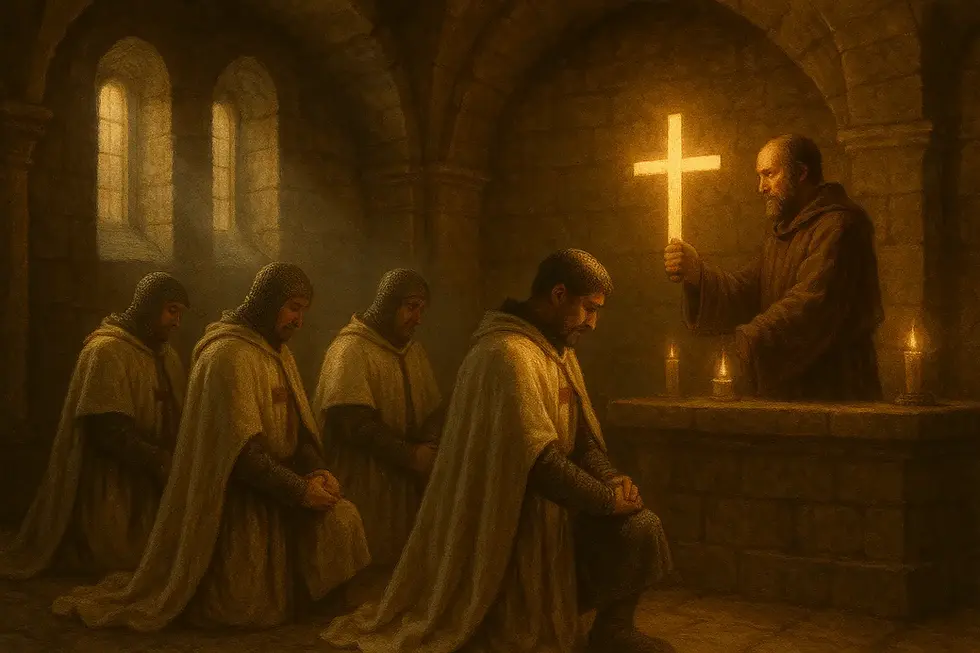
Soon, the Templars became far more than mere guardians of the roads. They built fortresses in the Holy Land, took part in the Crusades, commanded armies, and rose to become the spiritual elite of the warrior world. Their discipline and organization astonished their contemporaries — no other order could match them in hierarchy and obedience. Every knight knew his place, every sergeant his duty.
However, the mission of the Order was not limited to warfare. The Templars established the earliest forms of financial operations, accepting donations, owning lands and castles, providing loans, and ensuring the safe transfer of funds between the East and Europe. Becoming guardians not only of the pilgrims’ lives but also of their possessions, they gradually began to inspire a respect tinged with fear.
By the mid-12th century, the Templars had become a force respected by both popes and kings. Their ideal — “faith through discipline” — inspired thousands across Europe. What had begun as a brotherhood of nine humble knights had transformed into an order whose name became synonymous with sanctity, power, and mystery.
Power and Wealth of the Order
By the 13th century, the Order of the Temple had become one of the most powerful institutions of the medieval world. Their possessions stretched from England to the Holy Land, and their influence was felt in every corner of Europe. The Templars owned hundreds of castles, fortresses, and churches situated along key trade routes, allowing them to control the movement of goods and people.
Their military strength was immense — disciplined, well-armed, and fanatically devoted to their cause; they were regarded as the bulwark of Christendom against the Muslim East. Yet the true power of the Order lay not only in their swords but also in numbers — in money, land, and the debts of kings.

The Order developed a unique financial system, becoming, in essence, the first bankers of Europe. Pilgrims could deposit money at Templar commanderies in France and receive a letter allowing them to withdraw the same amount later in Jerusalem. This made travel safer, eliminating the risk of robbery along the way.
Over time, the Order began lending to monarchs, providing loans, and safeguarding royal treasuries. Even King Henry III of England kept his wealth in the Templars’ Temple in London.
The Order had the right to collect taxes, was exempt from duties, and answered only to the Pope, making it independent from secular authority. In Europe, this growing autonomy was met with increasing suspicion. The Templars, who lived under a vow of poverty, in reality possessed the wealth of a continent. Their castles were not merely fortresses but centers of administration where the fates of kingdoms were often decided.
The fame of the Order gave rise to legends. Rumors spread that the Templars had discovered ancient relics beneath the ruins of Solomon’s Temple — perhaps even the Holy Grail or the Ark of the Covenant. They were seen as keepers of secrets known only to the initiated. And though most of these tales were born from envy and fear, the Order itself deliberately surrounded its image with an aura of silence. Prayers whispered in the dark, nocturnal gatherings, and mysterious symbols only deepened their mystical allure.
Meanwhile, their growing power began to cause unease. Many monarchs, including King Philip IV of France, known as Philip the Fair, were deeply indebted to the Order. It seemed that the Order of the Temple had become a state within a state — with its own army, economy, and diplomacy. Their wealth had turned into a weapon pointed against them.
By the end of the 13th century, after the loss of Jerusalem and the fall of the last fortresses in the Holy Land, the military mission of the Order had lost its purpose. Yet their wealth and influence remained. The Templars still possessed immense resources, and an uneasy question began to echo more frequently: why did the world need an order that had lost its sacred mission? The answer would come in the form of conspiracy, dark accusations, and a pyre that would bring one of the most mysterious chapters in European history to an end.
The Fall: Conspiracy and the Trial of the Templars
By the early 14th century, the power of the Order of the Temple had become a source of open irritation for the monarchs of Europe, especially for King Philip IV of France, known as Philip the Fair. This ambitious ruler, obsessed with strengthening royal authority, owed the Templars enormous sums of money. The royal treasury was empty after endless wars and the extravagance of the court, while the Order remained wealthy, independent, and beyond the king’s control. The Templars, whose loyalty belonged solely to the Pope, refused to become tools of the crown. It was then that Philip decided — the Order must fall.
In 1307, on the early morning of October 13, by order of the king, mass arrests of Templars began across France. It was a carefully orchestrated strike: in a single day, thousands of knights were seized, including the Grand Master, Jacques de Molay. They were accused of grave crimes — heresy, devil worship, blasphemy, idolatry, and even obscene rituals. These charges were absurd, yet they carried a deadly cunning: in the eyes of the people and the Church, the Order was to appear not as defenders of the faith, but as traitors to Christ.
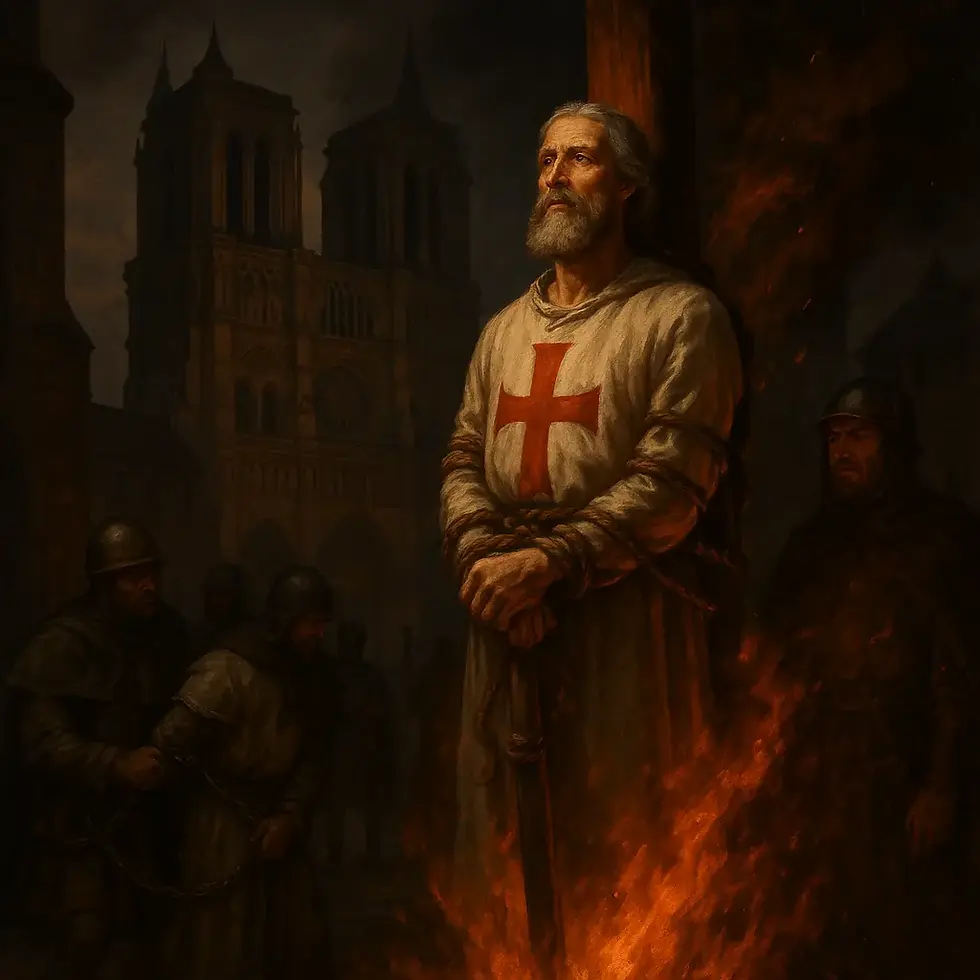
Under torture, many confessed to crimes they had never committed. The Inquisition demanded confessions, and silence meant death. Torture, starvation, and solitary confinement broke even the strongest among them. All of Europe watched in suspense as the once-proud and unshakable Order crumbled under the weight of lies. Pope Clement V, under the influence of Philip, was forced to yield — instead of defending the Order, he ordered its dissolution.
In 1312, the Order of the Temple was officially dissolved. Its property was transferred to the Order of the Hospitallers, yet a significant portion of its wealth mysteriously vanished. Even then, rumors began to spread that the Templar treasures had been hidden or secretly taken beyond the borders of France.
The final act of this tragedy took place on March 18, 1314. On that day, on the Île de la Cité in Paris, Jacques de Molay and Prior Geoffroi de Charnay were burned at the stake as heretics. Before his death, de Molay spoke words that would become legend: he summoned King Philip IV and Pope Clement to appear before the judgment of God within a year. According to legend, his prophecy came true — both men died within the following months.
Thus ended the story of the Order that once held both the sword and the prayer book, gold and mystery. The fall of the Templars became a symbol of how fear of a free and powerful force can destroy even those who once upheld the world. Yet with their demise, a new myth was born — a myth of curses, treasures, and secrets that survived the flames of the pyres.
The Legacy of the Templars and Legends That Lived On
After the burning of Jacques de Molay, the Order of the Temple vanished from the political stage — but not from humanity’s memory. Its death marked the beginning of a legend that only grew stronger with each passing century. The Templars ceased to be merely knights; they became a symbol of secret knowledge, eternal loyalty, and an unbroken spirit. Where history placed a period, mythology painted an entire universe of mysteries.
Almost immediately after the executions, rumors spread that part of the Order had survived. It was said that some knights managed to flee to Scotland, where they found refuge under King Robert the Bruce. Legends claimed that it was they who helped him win the Battle of Bannockburn, and that in Scotland the Order secretly continued to exist. Since then, countless theories have emerged suggesting that the Templars laid the foundations of Freemasonry, and that their symbols and rituals were later carried into the brotherhoods of the modern age.

A special place in these myths is reserved for the treasures of the Order. The vanished riches, never found by either Philip IV or the Pope, became fertile ground for countless legends. Some believe that the gold and relics were carried by sea to Portugal, where a group of knights joined a new Order of Christ, continuing under the same cross but under a different name. Others claim that among these treasures were the Holy Grail itself or the Ark of the Covenant, hidden away in the most inaccessible corners of Europe.
Yet the legacy of the Templars lies not only in hidden treasures and mysteries. Their image has become an inseparable part of European culture. Medieval chroniclers, Renaissance poets, and 19th-century novelists all saw in them something greater than a mere historical order. To some, they were martyrs who fell victim to envy and intrigue; to others, they were keepers of forbidden knowledge. With the rise of books, films, and even video games, the Order of the Templars has become a universal symbol of mysticism, faith, and power.
But perhaps their greatest legacy is the idea of devotion to an ideal. The Templars showed that faith and discipline can raise a person above kings — yet also make him vulnerable to the envy of the world. Their story reminds us that every great power inspires fear, and every great faith — doubt. And perhaps that is why, seven centuries later, the name of the Templars still echoes — not as a memory of the past, but as the whisper of an eternal mystery fading into the depths of time.


Comments