The Fall of the Mongol Empire: Why the Greatest Power of the Middle Ages Collapsed
- Jan 2
- 9 min read
At the beginning of the thirteenth century, the world encountered a force unlike anything it had known before. From the steppes of Central Asia emerged an army that, within just a few decades, created the largest land empire in human history.
The Mongol Empire stretched from the shores of the Pacific Ocean to Eastern Europe, from the forests of Siberia to the deserts of the Middle East. To contemporaries, it appeared almost mythical — swift, ruthless, and seemingly utterly invincible.

The Mongol conquests shook the foundations of the medieval world. Ancient cities fell, entire states vanished, and long-established trade routes and political balances were transformed. Armies once considered the strongest in their regions were defeated by highly mobile cavalry operating with terrifying precision and discipline.
Many chroniclers of the time were convinced that this empire was built to last forever, and that its rule represented an inescapable new reality.
History, however, took a different course. Barely a century after reaching the height of its power, the Mongol Empire ceased to exist as a unified state. In its place emerged separate khanates and dynasties, often locked in conflict with one another. Centralized authority disappeared, and the once cohesive political system fractured into competing fragments.
For historians and readers alike, this fact inevitably raises a question: how could an empire that had conquered half the world collapse?
The answer is not as simple as it may seem at first glance. The fall of the Mongol Empire cannot be explained by a single cause — whether a military defeat, a conspiracy, or an economic crisis. It was a complex and gradual process in which struggles for power, internal contradictions, administrative challenges, and changes in the wider world became tightly intertwined.
What had once enabled the Mongols to build a vast empire gradually turned into its greatest vulnerability.
In this article, we will take a detailed look at why the greatest empire of the Middle Ages was unable to preserve its unity. We will examine the political, economic, and military factors, as well as the human dimension — the decisions and mistakes of those who inherited an empire forged through rapid conquest.
The Heirs of Genghis Khan and the Crisis of Power
The death of Genghis Khan in 1227 became the first serious test for the Mongol Empire. While he was alive, power rested on his personal authority, military genius, and ability to maintain a balance among the clan elites. After his passing, however, it became clear that the empire lacked a clearly defined and universally accepted mechanism for the transfer of power.
Formally, the supreme ruler — the Great Khan — was elected at a kurultai, but in practice this process increasingly turned into an arena of struggle between different branches of the Chinggisid lineage.
The first heirs still tried to preserve the appearance of unity. Ögedei, followed by Möngke, continued the policy of conquest and maintained control over vast territories. Yet even during this period, tensions within the ruling elite were steadily growing.

Each ulus pursued its own interests, and powerful khans were increasingly unwilling to submit to the center. The empire was expanding faster than its ability to be governed from a single political core.
After Möngke died in 1259, the crisis became overt. The struggle for the title of Great Khan between his brothers escalated into a full-scale civil war. For the first time, Mongol armies fought not external enemies, but one another.
This marked a turning point: the idea of a unified empire began to rapidly lose its real substance. Kurultais no longer brought the elite together; instead, they merely formalized divisions that already existed.
Particularly destructive was the fact that each new ruler sought support primarily from his own ulus and his closest circle. Loyalty to the empire as a whole gave way to personal and dynastic ambitions.
Under such conditions, the central authority became more of a symbol than an effective institution. The orders of the Great Khan were increasingly ignored whenever they conflicted with the interests of regional rulers.
It is also important that the very model of power, which had proven effective for a nomadic tribal confederation, was poorly suited to governing a multiethnic, multilayered empire. China, Persia, Russia, and Central Asia required different administrative approaches, yet instead of reforms, the elite were consumed by struggles for the throne.
As a result, the empire began to lose its internal coherence even before facing any serious external blows.
Thus, the crisis of succession became not merely a series of dynastic conflicts but a fundamental problem. It undermined trust among the elites, weakened centralized authority, and set in motion a process of fragmentation that could no longer be stopped.
The Fragmentation of the Empire: Uluses as Independent States
The political crisis at the top of the Mongol Empire inevitably led to its territorial fragmentation. By the second half of the thirteenth century, it had become clear that governing such a vast expanse from a single center was virtually impossible.
Formally, the empire continued to exist, and Great Khans were still proclaimed, but in practice, power was increasingly concentrated in the hands of the rulers of individual uluses — regions that were gradually turning into de facto independent states.
Originally, the uluses were conceived as components of a single imperial system. Each was governed by descendants of Genghis Khan and was meant to submit to the supreme authority. However, as the center weakened, the khans of the uluses began to pursue their own policies, guided above all by local interests.

For the rulers of the Golden Horde, the Ilkhanate, or the Chagatai Ulus, questions of internal stability and revenue increasingly outweighed the abstract idea of empire-wide unity.
The split became especially evident after the civil war over the title of Great Khan. From that point on, the uluses coordinated their actions with one another less and less. Moreover, conflicts, trade disputes, and even armed clashes began to arise between them.
What had once been considered internal affairs of a single empire now increasingly resembled relations between independent powers. Unity survived more in historical memory than in actual political practice.
Cultural differences also played an important role. In each ulus, the Mongol elite gradually adopted the traditions of the conquered peoples. In China, the rulers of the Yuan dynasty relied on Chinese bureaucracy; in Persia, the Ilkhans embraced Islam and structured governance according to local models; and in the steppes of Eastern Europe, the Golden Horde preserved nomadic traditions.
These differences deepened the sense of separation between the parts of the former empire and made a return to a unified model of authority increasingly unlikely.
Over time, the economic interdependence that had once held the empire together also disappeared. Shared trade routes came under the control of different centers, each seeking to extract the greatest possible benefit for itself.
Instead of coordination, competition emerged, and at times even open confrontation. This further undermined the foundations of what had once been a unified space.
Thus, the disintegration of the Mongol Empire was not a sudden collapse, but a gradual transformation of the uluses into independent states. Each of them followed its own historical path, retaining only a formal connection to a shared past.
Economic and Administrative Challenges of a Vast Empire
As long as the Mongol Empire continued to expand, its economic system rested on constant conquest, control of trade routes, and military plunder. However, once active expansion began to slow, it became clear that governing the territories already conquered required an entirely different approach.
An empire created as a military machine proved poorly suited to long-term economic and administrative management.
One of the key problems was the economy. During its peak, the Mongols controlled a significant portion of the Silk Road, which ensured a steady flow of taxes and goods. But as the unified center disintegrated, trade routes began to fragment.

Each ulus sought to extract benefits for itself, introducing its own duties and restrictions. This undermined transit trade, reduced revenues, and made the economy less stable. What had once bound the empire together now became a source of conflict.
Administrative difficulties were no less serious. The Mongol system of governance functioned effectively within a nomadic society and during military campaigns, but proved highly vulnerable when applied to the control of sedentary civilizations.
China, Persia, Russia, and Central Asia possessed complex bureaucratic traditions that required adaptation and reform. Yet instead of building a unified and effective administrative system, each ulus followed its own path, often adopting local models without any overarching coordination.
Tax policy also became a source of tension. In order to maintain the army and the court, rulers increased the tax burden on the population. Combined with corruption among officials, this provoked resentment among merchants, farmers, and artisans.
In a number of regions, people began to view Mongol rule not as a guarantor of order and security, but as a heavy burden. This undermined loyalty and created fertile ground for uprisings.
An additional problem was the weakening of the infrastructure. The Yam postal system, which had once ensured rapid communication between regions, gradually fell into decline. Without reliable lines of communication, the central authorities lost control over the outskirts, and decisions were made slowly—or failed to reach their recipients at all. Across such vast distances, this meant a de facto loss of governability.
In the end, economic and administrative problems deepened the political divisions that already existed. The empire ceased to function as a single organism and instead became a collection of fragmented systems. Even without external enemies, it faced a crisis that was steadily eroding it from within.
Uprisings, External Enemies, and Military Defeats
By the time internal contradictions and economic difficulties had weakened the Mongol Empire, new forces emerged on the historical stage, ready to exploit its vulnerability. Uprisings among conquered peoples and the growing strength of external rivals became the factors that turned a slow decline into an irreversible process.
The empire increasingly found itself forced to defend rather than advance, a serious испытание for a military model built around constant expansion.
One of the most painful blows came from mass popular uprisings. In China, resentment over heavy taxation, corruption, and discrimination erupted into large-scale resistance movements. Particularly devastating was the Red Turban Rebellion, which undermined the authority of the Mongol Yuan dynasty and ultimately led to its collapse.
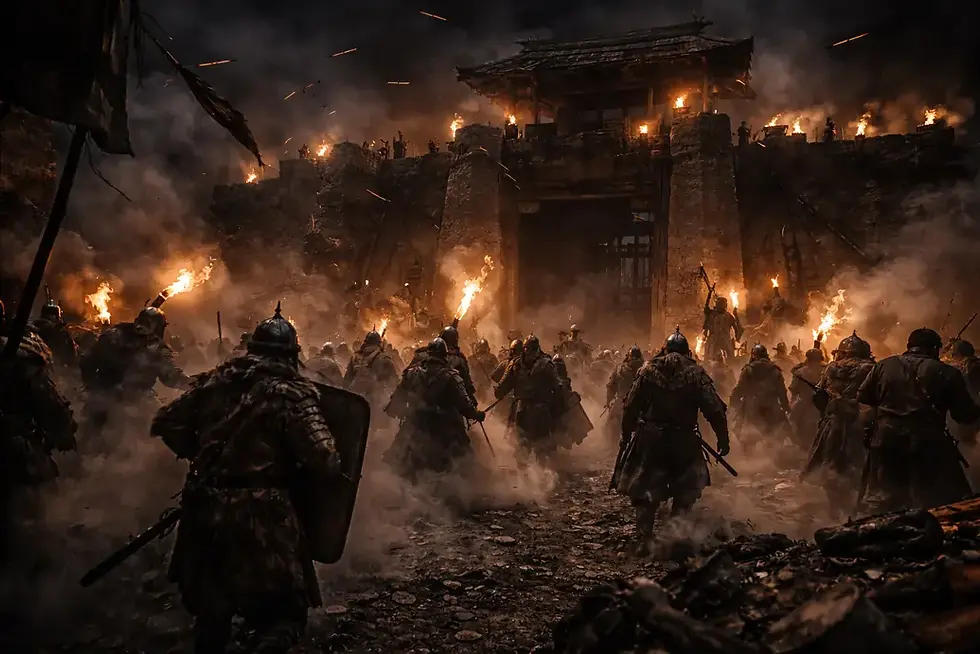
For the local population, Mongol rule was increasingly associated not with order, but with chaos and injustice.
At the same time, external enemies were growing stronger. In the Muslim world, Mongol expansion was halted by the Mamluks, who managed to adapt their tactics and inflicted a crushing defeat on the Mongols. This marked a major psychological turning point: the myth of the Mongol army’s invincibility was shattered. In Eastern Europe, local states were gaining strength, gradually freeing themselves from dependence and increasingly challenging the authority of the Horde.
Over time, even the Mongols’ military superiority ceased to be absolute. Their opponents adopted Mongol tactics, strengthened city fortifications, and created their own mobile armies. In addition, internecine conflicts between the uluses steadily eroded military power from within. Instead of acting together, the former components of a once-unified empire wasted their strength fighting one another.
The factor of exhaustion should not be underestimated either. Constant wars, the suppression of uprisings, and the need to hold vast territories drained resources. An army once driven by the momentum of conquest and the promise of rich plunder increasingly faced shortages of manpower and funds. Military service ceased to be a source of glory and profit, which in turn lowered morale.
As a result, the Mongol Empire found itself in a situation where external pressure coincided with internal crisis. Uprisings deprived it of support among the population, while defeats on the frontiers undermined the authority of the power. Even in regions where the Mongols formally retained control, their rule became increasingly fragile and dependent on compromise.
Conclusion: Why the Fall of the Mongol Empire Was Inevitable
The fall of the Mongol Empire is often perceived as a sudden and dramatic collapse, but in reality, it was a long and largely inevitable process. The empire did not fall in a single moment, nor was it destroyed by one decisive external blow. Instead, it disintegrated gradually, under the weight of internal contradictions accumulated over decades of rapid expansion. What had once been the source of its strength eventually became its greatest weakness.
One of the key reasons was the sheer vastness of its territories. Governing a realm encompassing dozens of peoples, cultures, and economic systems proved nearly impossible without strong institutions and a stable center. Mongol rule initially rested on the personal authority of its rulers and strict military discipline, but this was not enough for the long-term management of a complex, multiethnic world.
Once the figure capable of keeping the elites in line disappeared, the empire began to fall apart.

No less important was the human factor. The heirs of the great conquerors inherited an immense legacy, yet often lacked both political foresight and a willingness to compromise. Internal conflicts, personal ambitions, and struggles for the throne undermined unity more effectively than any external enemy ever could.
Instead of reform and adaptation, the system increasingly responded to crises with force, which only accelerated its decay.
Economic and administrative difficulties completed this process. Once the flow of military plunder dried up, it became clear that the old model could not ensure sustainable development. Trade declined, taxation bred discontent, and governance turned into a collection of fragmented decisions. The empire lost its ability to function as a single organism, and its parts began to live by their own rules.
Uprisings and external blows became the final link in this chain. They did not so much destroy the empire as accelerate an inevitable ending. By that point, Mongol authority had already been weakened from within and could no longer respond effectively to challenges. Even the military tradition that had long ensured dominance ceased to guarantee success.
The history of the Mongol Empire’s fall vividly demonstrates that conquering the world is far easier than holding it. Scale, speed, and military power secured the Mongols a unique place in history, but without durable institutions and a unified political will, such a state could not endure indefinitely.
Nevertheless, its legacy outlived the empire itself — in trade networks, cultural exchanges, and a transformed map of Eurasia. For this reason, the fall of the Mongol Empire remains not only a historical fact but also a powerful lesson about the nature of power, strength, and human potential.


Comments