Kublai Khan: The Emperor Who Created the Yuan Dynasty
- Jan 30
- 11 min read
Kublai Khan entered history not as a typical Mongol conqueror, but as a ruler who managed to transform the very nature of the empire he inherited. He was the grandson of Genghis Khan—a man whose name is associated with lightning-fast conquests, brutal campaigns, and a nomadic war machine. Yet Kublai’s fate unfolded differently. He was born into a world where the Mongol Empire already existed, but had not yet taken on a stable and lasting form.
Kublai was born in 1215, at a time when the Mongols were only beginning to grasp the full scale of their victories. He was the son of Tolui, Genghis Khan’s youngest son, and from an early age lived in the shadow of more famous and experienced relatives. Yet this position worked to his advantage. It allowed him to grow up away from constant internal struggles, observing how conquered lands were governed rather than focusing solely on how they were taken.

Even in his youth, Kublai stood apart from many members of the Mongol elite. Raids and war spoils interested him less than order, administration, and the exercise of long-term power.
His worldview was shaped in large part by his exposure to Chinese culture. In southern China, where Kublai was sent to serve as a governor, he encountered a highly developed system of administration, a written tradition, a bureaucracy, and an economy based not on nomadic life but on settled society. For a Mongol ruler, this was a revelation.
Instead of destruction, he increasingly chose preservation and adaptation of existing institutions, realizing that they could be governed far more effectively than through the use of force alone.
Readers often ask: why was it Kublai—and not another grandson of Genghis Khan—who became a defining figure of his era? The answer lies in his ability to think beyond the traditions of the steppe. He respected his grandfather’s legacy but did not see it as the only possible path.
While other descendants of Genghis Khan continued to follow the logic of endless campaigns, Kublai began to view the empire as a complex organism—one that required stability, laws, and a solid economic foundation.
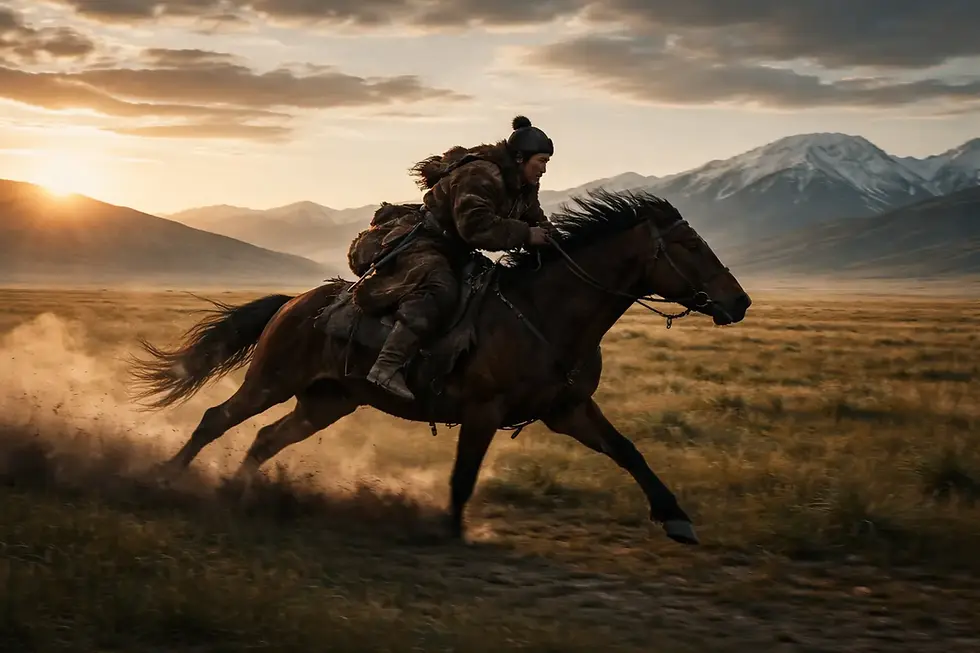
At the same time, he was never cut off from his Mongol roots. Kublai understood the military strength of his people, relied on loyal noyans, and knew the value of discipline. But unlike Genghis Khan, who built an empire in constant motion, Kublai was the one tasked with holding it together. His life became a bridge between the nomadic past and a settled future, between the world of the steppe and the civilization of China.
It is precisely within this tension—between origin and chosen path—that the key to understanding Kublai Khan’s character lies. He did not merely inherit an empire; he redefined its very meaning, laying the foundation for an entirely new form of rule that would soon become known as the Yuan dynasty.
The Struggle for Power: Kublai’s Path to the Title of Great Khan
The death of the Great Khan Möngke in 1259 marked a turning point not only in Kublai Khan’s fate, but in the history of the entire Mongol Empire. The vast state, stretching from Korea to Eastern Europe, suddenly found itself without a supreme ruler. At that moment, long-hidden tensions between different branches of the Chinggisid family rose to the surface, turning the question of succession into an open struggle for power.
Kublai’s main rival was his younger brother, Ariq Böke. Unlike Kublai, who had spent many years in China and was familiar with a settled system of governance, Ariq Böke relied on the traditional Mongol nobility and the nomadic elite of the steppe. He quickly secured the support of the old clans and was proclaimed Great Khan at a kurultai in Karakorum, the ancient capital of the empire.

Kublai, in turn, was declared khan at a separate assembly of nobles in northern China. Thus began a civil war that split the Mongol world apart.
This struggle was far more than a personal conflict between two brothers. It reflected a much deeper choice: whether the empire would remain a nomadic power living off conquest, or transform into a settled state with a stable administrative system. Ariq Böke embodied loyalty to the old traditions of the steppe, while Kublai represented a new model of rule, drawn from the civilizations the Mongols had conquered.
The war between the brothers lasted several years and was fought not only on the battlefield. Kublai skillfully used China’s economic resources, control over food supplies, and the support of educated administrators. He gradually deprived Ariq Böke of provisions and allies, understanding that under conditions of limited resources, even the most loyal army could not hold out for long.
Here, Kublai’s key difference from many Mongol rulers became clear: he thought strategically and with a long-term perspective.
By 1264, Ariq Böke was forced to admit defeat and surrender. Formally, Kublai became the Great Khan of the entire Mongol Empire, but in practice, his authority was no longer absolute. The western uluses—the Golden Horde, the Ilkhanate, and the Chagatai Khanate—were increasingly acting independently.
Nevertheless, victory in the civil war gave Kublai what mattered most: the freedom to pursue his own policies without having to defer to the steppe aristocracy.
It was after this victory that it became clear Kublai had no intention of ruling as his predecessors had. He chose China, stability, and institutional power. The struggle for the title of Great Khan was not the end for him, but a starting point—the moment after which the shaping of a new empire began, no longer nomadic, but imperial.
The Founding of the Yuan Dynasty: Why a Mongol Khan Became Emperor of China
Victory in the civil war gave Kublai Khan power, but it did not provide a ready answer to the central question: how to govern a vast and diverse realm. By the mid-13th century, the Mongol Empire was no longer a unified whole. The western uluses were acting with growing independence, while the traditional nomadic model of rule was ill-suited to governing a densely populated and economically advanced China.
It was at this moment that Kublai made a choice that would forever change the course of East Asian history.

In 1271, he officially proclaimed the founding of the Yuan dynasty and assumed the title of Chinese emperor. This step was unprecedented: for the first time, a descendant of Genghis Khan did not merely conquer China, but integrated himself into the Chinese imperial tradition. For the local elite, this signaled that the new ruler no longer viewed the country as a temporarily subjugated land, but as the very center of his power.
Readers often wonder whether this move was a sincere attempt at assimilation or a cold political calculation. In reality, it combined both motives. Kublai understood perfectly well that China could not be held by military force alone. A country with centuries of bureaucratic tradition required laws, institutions, and symbols of legitimacy.
By adopting a Chinese imperial title and dynastic name, he made his rule understandable and acceptable to millions of subjects.
At the same time, Kublai did not abandon his Mongol identity. The highest offices continued to be held by Mongols and members of other non-Chinese peoples, and society was divided into hierarchical groups. The Chinese population, especially those from the southern regions, occupied a lower position within this system. This created tension, but it also allowed Kublai to maintain control over both the elite and the army.
In this way, the Yuan dynasty became a compromise between nomadic rule and a settled, bureaucratic state.
The capital of the new empire became the city of Dadu, future Beijing. Its construction and expansion symbolized a shift of eras, from mobile khanly camps to a permanent center of power. The court, the administration, and the imperial residence were all located there. It was from Dadu that Kublai ruled his vast territories, seeking to combine Mongol military tradition with the Chinese system of governance.
It is important to emphasize that the founding of the Yuan dynasty was far more than a change of name. It marked a civilizational turning point, after which the Mongol Empire in the East definitively ceased to be nomadic. Kublai transformed from a Great Khan into an emperor, and his authority acquired the sacred and dynastic dimension long familiar to China.
It was this step that made Kublai Khan a unique figure among all the Chinggisids. He did not only conquer—he built. He did not simply inherit an empire; he deliberately reshaped it, laying the foundation for a state that would enter history as the Yuan dynasty.
The Yuan State from Within: Reforms, Economy, and Governance
After becoming emperor, Kublai Khan faced a challenge that none of his Mongol predecessors had ever managed to overcome: ruling a complex, multiethnic, and economically advanced state in times of peace. Conquering China proved far easier than organizing its everyday life. For this reason, Kublai’s reign became an era of large-scale reforms aimed at creating a stable and effective system of governance.
One of the major achievements of the Yuan dynasty was the creation of a centralized administration. Kublai Khan preserved many elements of the Chinese bureaucratic system, but adapted them to suit his own needs. Power was concentrated in the hands of the emperor and his court, while key positions were often held by Mongols, Muslim officials from Central Asia, and other non-Chinese figures. This approach weakened the influence of the local elite and prevented complete dependence on the traditional Confucian bureaucracy.

Kublai’s economic policy also attracted close attention from both his contemporaries and later historians. He actively supported trade, restored damaged canals and roads, and expanded the system of state grain granaries. Special emphasis was placed on paper money, which came into widespread use under the Yuan. In theory, this facilitated commerce and tax collection, but in practice, excessive issuance led to inflation and growing public discontent.
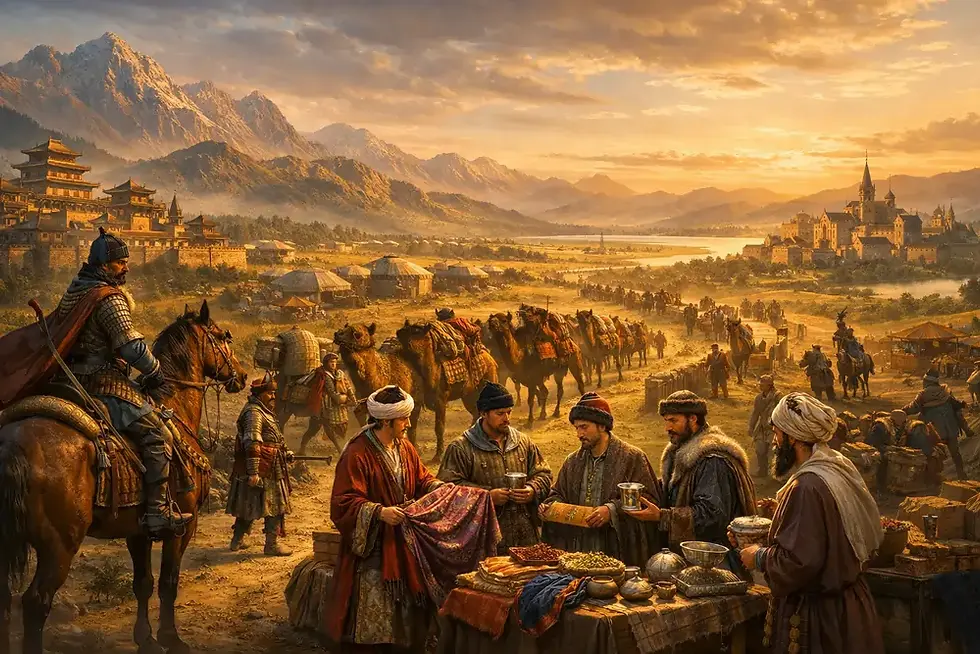
No less important was the postal and road system inherited from the early Mongol Empire. The yam network was expanded and transformed into an instrument of state governance. Through it, the emperor could rapidly receive information from distant regions, and orders reached governors far more quickly than under previous Chinese dynasties. It was precisely this system that astonished European travelers, including Marco Polo, who described the Yuan as an extraordinarily well-organized state.
However, the empire’s internal structure also had its weaknesses. The population was divided into rigid social categories, with Mongols at the top, followed by the so-called “colored-eyed” peoples of Central Asia, while the Chinese—especially those from the southern regions—occupied the lowest position in the hierarchy. This arrangement ensured control but undermined the loyalty of the majority of subjects and, over time, became a source of tension.
Kublai’s reforms showed that he sought not merely to hold onto power, but to create a functioning state mechanism. Yet this mechanism required a constant balance between Mongol interests and Chinese realities. As long as the emperor personally controlled the system, it functioned with relative stability. However, under his successors, it became clear that the complex structure of the Yuan state depended too heavily on the presence of a strong figure on the throne.
Nevertheless, it was under Kublai Khan that the Yuan dynasty reached its peak. His reforms transformed conquered China into a governable empire and demonstrated that Mongol rule could be not only destructive, but also constructive.
Wars and Ambitions: Korea, Vietnam, and the Failures in Japan
Despite his shift toward settled rule and administrative reforms, Kublai Khan remained a Mongol ruler in the broadest sense of the word. His authority rested on military power, and imperial prestige was still measured by the ability to expand the state’s borders. For this reason, the foreign policy of the Yuan dynasty was active and, in many ways, aggressive. Kublai sought to complete what his ancestors had begun: to establish Mongol dominance over the entire East Asian region.
One of the first targets was Korea. After a series of exhausting campaigns, the Goryeo state was forced to acknowledge the supremacy of the Yuan. Formally, Korea retained its own dynasty, but in practice it became a vassal, obliged to pay tribute, provide troops, and even enter into dynastic marriages with the Mongol ruling house. For Kublai, this was an important success: the peninsula became a strategic base for further maritime expeditions.

Campaigns in Vietnam and in the regions of what is now southern China proved far more difficult. There, Mongol armies faced not open steppe, but a humid climate, jungles, and a strategy of attritional warfare. Despite some victories, local rulers managed to preserve a degree of autonomy. These campaigns demonstrated that the traditional Mongol military model was not always effective in unfamiliar natural environments.
However, the clearest symbol of Kublai Khan’s military ambitions was the campaigns against Japan. In 1274 and 1281, he organized massive naval expeditions unlike anything previously seen in the history of the Mongol Empire. Enormous fleets, assembled with the help of Chinese and Korean shipbuilders, were meant to break the resistance of the island state. Both campaigns, however, ended in disaster. Storms—remembered in Japanese tradition as the “divine wind,” or kamikaze—destroyed much of the fleet.
These defeats had far-reaching consequences. They not only undermined the military prestige of the Yuan dynasty but also dealt a serious blow to the economy. Preparing the expeditions required enormous resources, requisitions, and mobilizations, which intensified public discontent. Moreover, the failures revealed the limits of imperial expansion: the sea proved to be an adversary that Mongol strategy was ill-equipped to overcome.
It is important to note that Kublai was not a reckless conqueror. His wars followed a clear political logic—control of trade routes, reinforcement of the vassal system, and demonstrations of power. Yet it was precisely these external campaigns that exposed the weaknesses of the Yuan state. A settled empire built on a cultural compromise proved vulnerable when its resources were spent on ambitions that brought no tangible results.
Kublai Khan’s campaigns became the final major expansionist efforts of the Mongol world. After them, the Yuan dynasty was increasingly forced to focus not on conquest, but on maintaining the power it already held—a task that would prove no less challenging.
The Legacy of Kublai Khan: Greatness, Contradictions, and the End of the Yuan Dynasty
Assessments of Kublai Khan’s reign have always been conflicted—and it is precisely in this ambiguity that his historical significance lies. He was the first Mongol ruler not merely to conquer China, but to attempt to integrate himself into its civilizational tradition. His legacy cannot be reduced either to the image of a brutal conqueror or to an idealized vision of an enlightened emperor. Kublai was a figure of transition, a man standing between two worlds.

On the one hand, it was Kublai who transformed the eastern part of the Mongol Empire into a fully functioning state. The Yuan dynasty had a capital, an extensive administrative apparatus, systems of taxation and law, and infrastructure that connected vast territories. Under Kublai, China once again became a center of international trade, and the Silk Road a secure corridor between East and West. Contacts with the Islamic world and Europe reached an unprecedented level, and for the first time in many centuries, China found itself open to the outside world.
On the other hand, many of the Yuan dynasty’s problems were laid down precisely during Kublai Khan’s reign. Social stratification—where Mongols and non-Chinese elites enjoyed privileges while the majority of the population remained at the lower levels of the hierarchy—undermined the stability of the state. Economic difficulties caused by excessive military spending and inflation further deepened public dissatisfaction.
After Kublai Khan's death in 1294, it became clear that the system depended far too heavily on the ruler’s personal authority.
His successors possessed neither his authority nor his political instinct. The court sank into internal intrigue, regional governors grew increasingly independent, and peasant uprisings became ever more widespread. For the Chinese population, the Yuan dynasty remained a foreign power despite Kublai’s efforts to grant it legitimacy. By the mid-14th century, the crisis reached its peak, and the state was no longer capable of maintaining control over the country.
In 1368, the Yuan rule was finally overthrown, and the Ming dynasty came to power. The Mongols were pushed back to the north, and China once again came under the rule of a native dynasty. Yet this did not mean the complete disappearance of Kublai Khan’s legacy. Many administrative practices, infrastructural solutions, and even ideas of centralized governance were adopted by those who followed.
Today, Kublai Khan is remembered as a man who dared to change the very essence of Mongol rule. He showed that an empire could exist not only through movement and conquest, but also as a settled state. His reign was a vast and risky experiment—one that did not fully succeed, yet left a profound mark on the history of China and Eurasia.
For this reason, Kublai Khan remains one of the most complex and compelling figures of the Middle Ages—an emperor who sought to unite the steppe and civilization into a single whole.

Comments