How did Napoleon Bonaparte die?
- Jun 27, 2024
- 9 min read
Updated: Oct 5, 2025
The name of Napoleon Bonaparte still makes the hearts of historians and ordinary people beat faster, even two centuries later. This Corsican officer who became Emperor of France was the embodiment of an extraordinary rise to power. His brilliant military campaigns shook the foundations of old Europe and redrew its map. He crowned himself, dictated laws to entire continents, and his fame echoed from Cairo to Moscow. But as often happens with those who rise too high, his fall was swift and devastating. Waterloo marked a decisive end to his political career, turning the ruler of Europe into a prisoner.

And here begins the most mysterious and tragic chapter of his life — exile. Instead of grand palaces, a tiny windswept island in the South Atlantic awaited him. Saint Helena. This remote place became his final refuge — a prison under the open sky. It was here, far from his homeland, surrounded by loyal yet powerless companions and under the constant watch of British guards, that Napoleon Bonaparte met his end on May 5, 1821.
But his death did not put a full stop to history. On the contrary, it sparked a wave of questions, debates, and theories that continue to this day. How did Napoleon die? What were the true causes of his death? The official version given by the doctors present at his passing pointed to a single illness. Yet almost immediately—and especially in the 20th century—voices began to suggest the possibility of murder. Was it a cruel but natural illness that claimed the life of a man already broken? Or was it someone's malicious intent, hidden behind the veil of exile? Napoleon’s death on the island of Saint Helena remains shrouded in mystery, and its secret continues to stir minds. So let us journey back to that distant past and try to uncover what happened during those May days of 1821.
Exile on Saint Helena: Life in Isolation
After the disaster at Waterloo in June 1815, Napoleon’s star finally set. His attempts to find asylum failed, and on July 15, he surrendered to the captain of the British ship Bellerophon. His hope of living quietly as an English gentleman quickly vanished. The British government, gripped by panic at the thought of another escape and a possible resurgence of the Napoleonic threat, chose a place of exile that seemed like a natural prison — the island of Saint Helena.
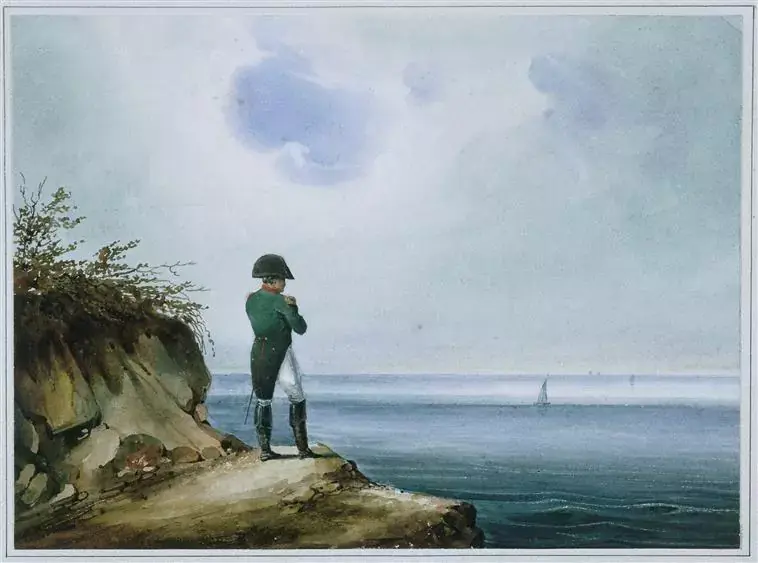
This tiny volcanic speck, lost in the vast expanse of the South Atlantic, lay thousands of miles from the nearest continent. The journey there aboard the Northumberland took a grueling ten weeks and was a trial in itself. When Napoleon first caught sight of the island’s bleak, jagged cliffs on October 15, 1815, his dark forebodings only deepened. It was here that he was destined to spend the rest of his life.

His residence became Longwood House, the former summer residence of the governor. Sounds prestigious? In reality, it was a damp, wind-battered, uncomfortable building. Constant humidity, sharp temperature fluctuations, relentless winds, and sparse vegetation created a depressing atmosphere. But worse than the physical conditions was the very regime of his confinement. Napoleon and his small entourage—a handful of loyal officers and servants—were kept under the relentless and humiliating watch of the British authorities.
The emperor’s chief jailer was the island’s appointed governor, Sir Hudson Lowe. A pedantic, paranoid, and tactless man, Lowe turned Napoleon’s life into a torment of petty nitpicking. Every movement of the prisoner and his entourage was strictly regulated. Specific boundaries were set for their walks, and stepping beyond them was forbidden under threat of force by the guards. All incoming and outgoing letters were subjected to the harshest censorship. Lowe demanded personal reports on Napoleon’s health and mood, insisted on official addresses referring to him as “General Bonaparte” (refusing to acknowledge his imperial title), which deeply insulted the prisoner.

In essence, Saint Helena became for Napoleon not just a place of exile, but a true island prison of the highest degree of isolation. This atmosphere of constant surveillance, humiliation, boredom, and separation from the world—compounded by the harsh climate—began to slowly but surely erode not only the spirit but also the health of the fallen emperor. He felt like a trapped animal, deprived of the most essential things—freedom and purpose. And it was under these conditions that the first troubling symptoms of the illness, which would ultimately lead him to his grave, began to manifest.
Symptoms and Decline: Napoleon Bonaparte’s Failing Health
Life at Longwood House—filled with despair, humiliation, and dampness—inevitably took its toll on Napoleon’s health. At first, his complaints were occasional: chills that seeped to the bone in the chilly house, fatigue, and apathy that he tried to mask by reading and dictating his memoirs. But by 1817, just a couple of years after arriving on the island, Napoleon’s health problems became increasingly apparent and alarming.
The first alarming sign was severe, spasmodic abdominal pain. It struck suddenly, crippling the emperor and forcing him to double over. This was accompanied by constant nausea and agonizing heartburn. The food he once loved and consumed eagerly—Napoleon was known for his simplicity and quick meals—now caused him disgust and discomfort. He began to lose weight noticeably. His once full, energetic face grew gaunt, his features sharpened, and a sickly pallor appeared.

His doctor, the Irishman Barry O'Meara, who had served in the British navy, was the first to document these symptoms of Napoleon Bonaparte. He noted not only the physical suffering but also the emperor’s depressed mental state—his bouts of melancholy that only worsened his physical condition. O'Meara’s sympathy for his patient quickly soured his relationship with Governor Lowe, and in 1818, the doctor was recalled from the island. He was replaced by other physicians, including Francesco Antommarchi, a Corsican sent by the Bonaparte family. Antommarchi meticulously recorded Napoleon’s health decline: the increasing frequency and intensity of pain, periodic vomiting, and growing weakness that made it increasingly difficult for the emperor to move even around the house. Swelling appeared in his legs.
By early 1821, it was clear that his condition was hopeless. Napoleon spent most of his days in bed or a chair, suffering from debilitating pain. Medicines offered little relief. He weakened visibly. Napoleon’s final days, especially in April and early May, were filled with unbearable suffering. The pain became nearly constant, and vomiting was agonizing. He writhed in fever, lost consciousness from the pain, and his speech grew increasingly slurred. Those who stayed with him until the end—his loyal generals Montholon and Bertrand, and his valet Marchand—watched in horror as the once most powerful man in Europe faded away. On May 5, 1821, after a long agony, Napoleon Bonaparte drew his last breath in his humble home on Saint Helena. According to reports, his body was wasted to the extreme by illness. But what exactly had undermined his iron health? Doctors tried to answer that question the very next day.
The Official Cause: Was It Stomach Cancer?
The day after his death, on May 6, 1821, the doctors who had attended the emperor’s final moments, along with British medical personnel, gathered in the drawing room of Longwood House. Under the supervision of Governor Lowe, they conducted an autopsy on Napoleon Bonaparte’s body. This procedure was intended to settle once and for all the question of the cause of Napoleon’s death and to dispel any rumors of foul play. What they discovered became the foundation of the official version for decades to come.
The main conclusion of Napoleon’s autopsy was shocking and seemingly indisputable. The emperor’s stomach was in a dreadful condition. According to Dr. Francesco Antommarchi, who led the autopsy, the stomach was significantly enlarged and adhered to the liver and surrounding tissues. On its inner surface, closer to the exit into the intestines, the doctors found a large, deep ulcer, which they believed was on the verge of perforation. But most importantly, nearly the entire remaining stomach lining was affected by an extensive, dense, and nodular tumor. Antommarchi and his colleagues definitively diagnosed advanced stomach cancer (carcinoma).

Stomach cancer was officially declared the cause of Napoleon’s death. The doctors stated that the disease had developed over a long period—likely years—and had reached its terminal stage. They attributed his agonizing symptoms in the final years—pain, nausea, vomiting, weight loss, and inability to eat properly—specifically to the progression of this malignant tumor. The autopsy report on Napoleon provided a detailed description of the pathological changes, leaving, at first glance, little room for doubt.
This version was further supported by family history. It is known that Napoleon’s father, Carlo Buonaparte, died of stomach cancer in 1785 at the age of just 39. Many doctors of the time—and modern researchers as well—see this as clear evidence of a genetic predisposition. The emperor’s lifestyle—constant stress, irregular eating habits (he often ate quickly and in large portions)—may have worsened the condition.
Thus, the medical conclusion appeared clear-cut: Napoleon Bonaparte died of a natural cause—complications from advanced stomach cancer. This version, based on visual examination during the autopsy and supported by family medical history, was long considered definitive. It explained the prolonged decline in his strength, the specific symptoms, and seemed a logical end for a man whose body had endured immense stress and the blows of fate. His father’s death from the same illness added a sense of tragic inevitability. It seemed the mystery was solved.
But then—why, decades later, did this version come under such fierce scrutiny? Why did suspicions arise that the autopsy report might not be entirely truthful, or that the doctors may have missed or misinterpreted something? The answers lie in a realm of intriguing alternative theories.
Alternative Theories: Poisoning or Natural Death?
For decades, the official verdict of stomach cancer was accepted as the ultimate truth. However, in the 1960s, the story of Napoleon’s death took an unexpected and sensational turn. Swedish toxicologist and forensic expert Sten Forshufvud, a passionate admirer of Napoleon, decided to apply modern scientific methods to settle once and for all the question of what had caused the emperor’s death. His research sparked one of the most heated debates in historical and medical circles.
Forshufvud gained access to a priceless source—preserved strands of Napoleon’s hair. Hair acts as a “chemical diary,” retaining substances that enter the bloodstream. Using neutron activation analysis, a highly precise method, he discovered abnormally high levels of arsenic in Napoleon’s hair. This wasn’t limited to a single sample: elevated concentrations were found in strands from different years—1816, 1817, 1818—and even in a lock cut right after his death. In some cases, the arsenic levels exceeded normal limits by dozens of times.
This discovery shook the historical community. Had Napoleon been poisoned? Forshufvud became the chief proponent of the theory that Napoleon was deliberately poisoned with arsenic. But who could have been the killer? Naturally, suspicion fell on the British—particularly the despised Governor Sir Hudson Lowe. The motive? To eliminate an inconvenient prisoner whose very existence, despite isolation, still troubled London and gave hope to Bonapartists.
The theory proposed a slow, deliberate administration of poison—chronic arsenic poisoning—which could explain the prolonged illness and symptoms that partially mimicked cancer: pain, vomiting, weight loss, and weakness. Supporters of this theory also pointed to oddities in the behavior of Napoleon’s doctors and possible tampering with the autopsy report.
However, this gripping conspiracy theory met with serious opposition. Critics presented several counterarguments:
Arsenic was everywhere: In the early 19th century, arsenic was ubiquitous. It was used in medicines (even as a tonic!), in pesticides for rat control on ships and homes, and in dyes for fabrics and wallpapers—especially the popular bright “Scheele’s Green,” which was arsenic-based. The damp, mold-infested Longwood House could have emitted toxic fumes from mildew-covered wallpaper. Arsenic could also have entered food and wine from the surrounding environment.
The symptoms don’t quite match: Chronic arsenic poisoning often causes skin hyperpigmentation and hyperkeratosis (thickening of the skin, particularly on the palms and soles), which, according to descriptions, Napoleon did not exhibit. Moreover, the cancerous tumor described during the autopsy was real and extensive.
Who and how? No one has ever been definitively proven to have deliberately poisoned Napoleon. There is no direct evidence or confession to support the claim.
So what, then, killed Napoleon? Today, most serious historians and medical experts lean toward a compromise version: the primary cause of death was indeed advanced stomach cancer, worsened by genetics and prolonged stress. However, the abnormally high levels of arsenic in his system—whether from the environment, medications, or some other source—may have weakened his immune system, poisoned his body, and intensified his suffering, making the course of the illness even more agonizing. Napoleon’s death on Saint Helena remains a dramatic finale, where a tragic disease intertwined with the harsh conditions of exile—and perhaps the invisible poison of the era. The mystery of Saint Helena continues to captivate the imagination, reminding us that even the death of a great emperor can remain shrouded in doubt.


Comments